Thankfully this year there is a reprieve on standardized testing in California. If there is one lesson learned while I was in Texas during our little testing hiatus last year, do not take this "gift" for granted. The accountability still stands, whether formal or informal. The math material covered in this school year plays a direct role in how successful a student will be next year. If you are noticing a slide now do all that is possible to stop the trend. As math builds upon itself, the slide will continue if not addressed as early as possible.
With spring officially here, school is in its homestretch and sooner or later some form of end of year assessment will take place. Encourage your student to learn from past mistakes to increase their success. Some teachers use a type of "Reflection Report" where the students have to categorize the type of mistake made to bring awareness to yourself so you do not go on repeating the same error. Once students have that "ah-ha" moment they tend to avoid making it again in the future. It is often eyeopening for kids to see how their scores were impacted by repeating the same type of error many times in a row.
For your student to benefit from their mistakes, it is best to reference old homework, quizzes and tests and track where points were lost. Did they out and out get the whole problem wrong because they are deficient in a concept? Did they rush and not really answer what was asked? Are their facts off? Did they lose a point here and there due to "not reducing" or "labeling" their units? Next time they prepare for a test, any test, have them consider the following:
Concept Mistakes: This is when your problem solving process is off-course. You may not understand or mix up the steps it takes to reach a solution. You are multiplying instead of adding, you forgot to take the reciprocal of a number, you aren't combining like terms, you needed to convert something first. Do I need to practice more of these types of problems or meet with a math tutor and have it retaught to me? If they struggle with adding or subtracting mixed numbers, chances are a quiz with ten of these problems will not go well.
Comprehension Mistakes: You are solving for the first part of the problem, but missing the second part in multistep problems. The question asks for which one is NOT but your answer solves for which IS. Make sure you reread the question to make sure your solution has an appropriate answer. Did I solve for the type of unit they are asking me for? Do I understand the vocabulary in the question so I know what I am supposed to do?
Calculation Errors: Did you forget to regroup? Did you not take your solution to its lowest terms as required? Were all like terms combined properly? Is my place value off because my writing was not aligned or slightly sloppy? Am I rushing too much? Many times the kids complete the process 100% correctly (the more difficult part of problem solving) but if their facts are off they will never get the right answer.
These details are the difference between grade they currently have and one that is a level or two higher for middle and high school students. In elementary school it is the difference between getting a 2 on the report card or a 3 or a 4. The details build confidence in a child's mathematical ability. For younger students in elementary math, their attention to detail leads to prealgebra and algebra success. Algebra success leads to higher scores in more complex math courses students take in high school.
At Mathnasium of 4S Ranch we build a students confidence by working with them on concepts they struggle with or introduce new concepts to broader their math world. We set up good habits from the start that ensure future success so kids go into their classrooms feeling prepared.
Click here for the full article from Business Wire with an interview by Mathnasium founder and Chief Instructional Officer Larry Martinek.
Image retrieved on 3/19/14 from here.
Wednesday, March 19, 2014
Friday, March 7, 2014
The "Common Core" Way to Problem Solve
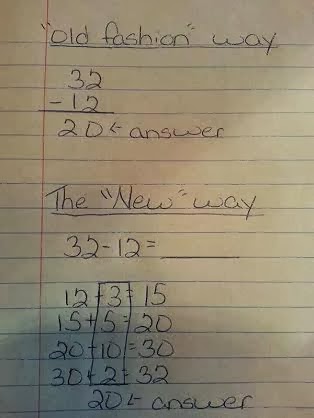
I honestly can't remember the source of this picture, although it came across my Facebook news feed repeatedly. As parents, we know how we learned math. The teacher showed us the traditional algorithm and we just did it. Concerned moms and dads constantly come into our center frustrated because they can't help their student since they "aren't doing it right."
Why does it have to be this way? Why are Common Core Standards making it more complicated? That is a huge national debate I will let the experts defend, but it is our kid's reality for now. The powers that be want the kids to know where the numbers are coming from and improve number sense. For many kids, they don't need all the pitstops along the way to get to the answer and the requirement of dragging out a solution actually becomes a huge turn off of math in general, or leads to careless mistakes, or leaves them more confused than just going with the "old school" way.
At Mathnasium of 4S Ranch we are striving to support our students in the ways presented by their teachers, but to also let kids know sometimes there are other ways to reach the same answer. Isn't the bottom line 32-12=20. Kids need to build up their own personal toolbox of math kids that make sense to them so they can think on their feet in the real world. All this work for 32-12 is for an early elementary math student, just imagine something more complex and the steps for prealgebra, algebra, geometry, trig or calculus! No wonder frustrated parents are seeking out quality math tutoring.
This is why I love our tagline: We Make Math Make Sense. Visit or call our center in 92127 to learn more.
Why does it have to be this way? Why are Common Core Standards making it more complicated? That is a huge national debate I will let the experts defend, but it is our kid's reality for now. The powers that be want the kids to know where the numbers are coming from and improve number sense. For many kids, they don't need all the pitstops along the way to get to the answer and the requirement of dragging out a solution actually becomes a huge turn off of math in general, or leads to careless mistakes, or leaves them more confused than just going with the "old school" way.
At Mathnasium of 4S Ranch we are striving to support our students in the ways presented by their teachers, but to also let kids know sometimes there are other ways to reach the same answer. Isn't the bottom line 32-12=20. Kids need to build up their own personal toolbox of math kids that make sense to them so they can think on their feet in the real world. All this work for 32-12 is for an early elementary math student, just imagine something more complex and the steps for prealgebra, algebra, geometry, trig or calculus! No wonder frustrated parents are seeking out quality math tutoring.
This is why I love our tagline: We Make Math Make Sense. Visit or call our center in 92127 to learn more.
Friday, February 28, 2014
The Saddest Math Picture Ever
I literally felt punched in the stomach when this picture came across my news feed. A viral image taken by a professional photographer of her own 2nd grade child who is frustrated beyond belief over their math homework. Kids with high work ethics put so much pressure on themselves for perfection and have meltdowns when mistakes are made. This was my son ten years ago.
My own son had plenty of moments like this in the 2nd-3rd grade window. When we moved from Dallas to San Diego last summer we were both reminded of that period of time. The movers pulled back the big TV from the built in cabinet and there were six snapped pencil halves. My now 17 year old son noticed them first and asked why all the broken pencils were back there. I reminded him of all the temper tantrums he used to throw during homework time. He would go from hard worker to pencil snapper in a split second and throw the pencil across the room. Apparently some of those bits got trapped behind the TV.
We laughed it off since almost ten years had passed, but as a parent I remember calming him down, making him walk away for a while to clear his brain, and at times NOT turning in the homework on time as it was such a negative experience and I needed my kid to feel like a kid and be happy.
It was these situations that led me from stay at home mom to earning my teaching credentials, becoming an elementary school teacher, math curriculum writer, and ultimately an administrator responsible for integrating 21st Century skills into the lessons delivered on our elementary campus. I want kids to understand math. Not just the rules, but the whys. How did those numbers get there? How can I move them more flexibly?
Our math tutors offer quality math instruction that prepares elementary school children for middle school, middle schoolers for prealgebra and algebra, and supports all levels of high school math including advanced algebra, geometry, statistics, precalculus and calculus.
The outburst changes as the kids get older. Tears and snapped pencils turn into mood swings, bad moods, withdrawn, insecurity of intelligence, and other self-esteem issues. If you see this nightly, come talk to us and let's see if we can be of help. We identify and help fill critical math gaps, present lessons one on one so it makes sense to the child, and provide homework help so your time with them in the evening is less stressful.
My own son had plenty of moments like this in the 2nd-3rd grade window. When we moved from Dallas to San Diego last summer we were both reminded of that period of time. The movers pulled back the big TV from the built in cabinet and there were six snapped pencil halves. My now 17 year old son noticed them first and asked why all the broken pencils were back there. I reminded him of all the temper tantrums he used to throw during homework time. He would go from hard worker to pencil snapper in a split second and throw the pencil across the room. Apparently some of those bits got trapped behind the TV.
We laughed it off since almost ten years had passed, but as a parent I remember calming him down, making him walk away for a while to clear his brain, and at times NOT turning in the homework on time as it was such a negative experience and I needed my kid to feel like a kid and be happy.
It was these situations that led me from stay at home mom to earning my teaching credentials, becoming an elementary school teacher, math curriculum writer, and ultimately an administrator responsible for integrating 21st Century skills into the lessons delivered on our elementary campus. I want kids to understand math. Not just the rules, but the whys. How did those numbers get there? How can I move them more flexibly?
Our math tutors offer quality math instruction that prepares elementary school children for middle school, middle schoolers for prealgebra and algebra, and supports all levels of high school math including advanced algebra, geometry, statistics, precalculus and calculus.
The outburst changes as the kids get older. Tears and snapped pencils turn into mood swings, bad moods, withdrawn, insecurity of intelligence, and other self-esteem issues. If you see this nightly, come talk to us and let's see if we can be of help. We identify and help fill critical math gaps, present lessons one on one so it makes sense to the child, and provide homework help so your time with them in the evening is less stressful.
Wednesday, February 26, 2014
"Less is More" can be Boring to Many
I came across an article highlighting efforts to teach math at an elementary school in rural Florida the other day. I agree whole-heartedly that students need to understand where and when numbers are coming from. I call it "building your math toolbox," and when the going gets tough in the math classroom, students can rely on those nuts and bolts lessons to kick start problem solving.
In the "Less is More" article they shared a day in a classroom where only four problems were covered. On one, the teacher worked out a division problem that modeled 72 divided by 6 and proceeded to tally mark all 72 "somethings" into six circles. This is necessary to demonstrated the operation of division, I've used the strategy myself (never with 72, however, as that would take FOREVER, she must love tally marks!) to distinguish two forms of division (when you know the groups but now how many is in the group or when you know how many are in the group but no idea how many groups there are). She is building number sense and experiences like this lead to numerical fluency in multiplication and division facts.
For the students who "get" division, though, that was probably the longest hour of their math lives. Students with a rock solid math foundation would have picked up the process and procedure early on and were probably anxious to try their own. Only the class was stilllllll counting out 72 tally marks. Maybe the class could have broke off into smaller problem solving groups or pairs for kids to try some on their own. That wasn't covered in the article, so it is unfair to say it didn't happen, but it does provide a snapshot of when your kid comes home and says they are bored in math class.
Enrichment in math is essential for kids who have the interest, requisite skills, and motivation to learn more. Mathnasium is the perfect place for this as we build a customized learning plan around your student's abilities. Holes are filled initially (if there are any), but then introducing new concepts follows, and this sets your child up for success as their math options diversity after elementary school. Having a solid understanding of elementary leads to algebra-readiness.
Give a call to learn more and see how our Power Math Workouts will benefit your child long term. 858-312-8888.
The full article can be read: http://wusfnews.wusf.usf.edu/post/why-less-more-rural-florida-school-preparing-common-core#.UwvdcFJLp4c.facebook
Sunglasses image retreived on 2/26/14 from: http://www.dogpile.com/info.dogpl.t10.4/search/images?fcoid=417&fcop=topnav&fpid=2&q=72+tally+marks&ql=
In the "Less is More" article they shared a day in a classroom where only four problems were covered. On one, the teacher worked out a division problem that modeled 72 divided by 6 and proceeded to tally mark all 72 "somethings" into six circles. This is necessary to demonstrated the operation of division, I've used the strategy myself (never with 72, however, as that would take FOREVER, she must love tally marks!) to distinguish two forms of division (when you know the groups but now how many is in the group or when you know how many are in the group but no idea how many groups there are). She is building number sense and experiences like this lead to numerical fluency in multiplication and division facts.
For the students who "get" division, though, that was probably the longest hour of their math lives. Students with a rock solid math foundation would have picked up the process and procedure early on and were probably anxious to try their own. Only the class was stilllllll counting out 72 tally marks. Maybe the class could have broke off into smaller problem solving groups or pairs for kids to try some on their own. That wasn't covered in the article, so it is unfair to say it didn't happen, but it does provide a snapshot of when your kid comes home and says they are bored in math class.
Enrichment in math is essential for kids who have the interest, requisite skills, and motivation to learn more. Mathnasium is the perfect place for this as we build a customized learning plan around your student's abilities. Holes are filled initially (if there are any), but then introducing new concepts follows, and this sets your child up for success as their math options diversity after elementary school. Having a solid understanding of elementary leads to algebra-readiness.
Give a call to learn more and see how our Power Math Workouts will benefit your child long term. 858-312-8888.
The full article can be read: http://wusfnews.wusf.usf.edu/post/why-less-more-rural-florida-school-preparing-common-core#.UwvdcFJLp4c.facebook
Sunglasses image retreived on 2/26/14 from: http://www.dogpile.com/info.dogpl.t10.4/search/images?fcoid=417&fcop=topnav&fpid=2&q=72+tally+marks&ql=
Thursday, February 20, 2014
What Makes Algebra Easier
I can't say these concepts make algebra easy, but definitely easier. Isn't that the goal? To make something completely understandable by having the proper math foundation that each lesson logically flows to the next? For that to happen, a student's brick wall of math can't have missing bricks!
The National Math Advisor Panel stated way back in 2008 that there are three critical skills that students must master for algebra to go smoothly. They are:
Image retreived 2/19/14: http://www.a4maths.com.au/userfiles/images/brickwall%20falling%20small.jpg
The National Math Advisor Panel stated way back in 2008 that there are three critical skills that students must master for algebra to go smoothly. They are:
- Effortless recall and fluency of basic math facts
- Fluency with fractions and how they interchange with decimals and percentages
- Certain aspects of geometry and measurement
To become fluent may occur naturally to some, but for others it takes practice. Having a firm grip on where the numbers are coming from is a start. How do you turn a fraction into a decimal? Or vice versa? Does your student "get" that percents, fractions and decimals are three ways to show something of the same value? That if we shared a cookie equally, I would get 50%, or 1/2, of .5 of that cookie. That benchmark is fairly easy, but what if there were eight of us sharing a twelve-cut pizza? I would get 11/2 slices, which is 1/8 of the pizza, or 12.5% of the pizza, or .125 of it. If you know the mathematical process, you should be able to figure out sharing that pizza if there are seven people or 15 people.
Algebra readiness is essential since all prior math leads to algebra and your student's success in the course. Success in algebra leads to further success for all future math. The pressure to get your child in algebra as early as possible is high but don't let it push your child into a math path they are not equipped to handle. Once they are in it they are in it. It can be a challenging and exciting path, or four years or frustration and struggle.
This summer Mathnasium of 4S Ranch will offer sessions to prepare your child for what lies ahead. Consider our summer sessions which include a "punch card" format to work flexibly with your summer plans. Get their brain charged with algebraic thinking and practice the essential skills with quality math instructors who make math make sense so algebra is understood from Day 1. We are here to help!
Algebra readiness is essential since all prior math leads to algebra and your student's success in the course. Success in algebra leads to further success for all future math. The pressure to get your child in algebra as early as possible is high but don't let it push your child into a math path they are not equipped to handle. Once they are in it they are in it. It can be a challenging and exciting path, or four years or frustration and struggle.
This summer Mathnasium of 4S Ranch will offer sessions to prepare your child for what lies ahead. Consider our summer sessions which include a "punch card" format to work flexibly with your summer plans. Get their brain charged with algebraic thinking and practice the essential skills with quality math instructors who make math make sense so algebra is understood from Day 1. We are here to help!
Image retreived 2/19/14: http://www.a4maths.com.au/userfiles/images/brickwall%20falling%20small.jpg
Wednesday, February 19, 2014
"Getting" Fractions Leads to Algebra Success
Fractions. We start off learning about them as sharing a pizza or a cookie equally among "x" number of people and it takes off from there. It is said among algebra teachers across the country, that having the ability to work flexibly with fractions (plus have great multiplication skills and a certain number of geometry and measurement skills, but I'll save that for another post) is essential for algebra success. It can be a matter of making or breaking your math path.
So how do we know if our kid is up for the algebra challenge? Are they "algebra ready?" Math standards even call these requisite skills algebra readiness for a reason. You need them to be ready for algebra. These skills begin as young as third grade and build in complexity, so keeping up with the ramp up is key.
Students should be able to:
- Recognize patterns with fractional parts and be able to "decompose" a fraction to its smallest form (EX: 3/4 = 1/4 + 1/4 + 1/4)
- Find and create equivalent fractions
- Add, subtract, multiply and divide fractions with common or uncommon denominators
Somewhere along the way, fractions no longer became sharing pizza and cookies, it became probability, ratios, proportions, unit rates, and then comes algebra. Working flexibly with the whole numbers and fractional numbers is critical, but efficiency is just as important. If too much effort is expended on these "nuts and bolts" items, then they begin to slow down the problem solving process.
If you find your child is not efficient or successful in their fraction sense, they could benefit from Mathnasium of 4S Ranch's program. We build a custom learning plan just for them and their needs and introduce every lesson in a way that makes sense to them.
Common Core Math Standards can be reviewed here: http://www.corestandards.org/assets/CCSSI_Math%20Standards.pdf
Tuesday, February 4, 2014
Need Math Help? Don't Call 911!
Here is a funny audio clip of a little one who needed help with their math so they called 911! We know math help can be an emergency sometimes, and that's why we love that students can drop in and get the help they want exactly when they need it. Unlike the friendly, yet unhelpful, phone operator, our expert math tutors will walk struggling students through the problem solving process.
Common Core expectations have made math somewhat confusing to kids and their parents. Much of the "answers" aren't necessarily numeric anymore. The requirement to not only solve, but to explain the steps you took to solve is essential. Having a firm understanding of what you are doing and why you are doing it is essential.
So whether it's prealgebra or algebra help, geometry or even calculus, you just need to call 858-312-8888 to reach Mathnasium of 4S Ranch. We'll get you covered!
Enjoy: http://www.wimp.com/kidmath/
Common Core expectations have made math somewhat confusing to kids and their parents. Much of the "answers" aren't necessarily numeric anymore. The requirement to not only solve, but to explain the steps you took to solve is essential. Having a firm understanding of what you are doing and why you are doing it is essential.
So whether it's prealgebra or algebra help, geometry or even calculus, you just need to call 858-312-8888 to reach Mathnasium of 4S Ranch. We'll get you covered!
Enjoy: http://www.wimp.com/kidmath/
Subscribe to:
Posts (Atom)