Showing posts with label math tutoring. Show all posts

Monday, September 29, 2014

Is Your Child "On Board" with Improving in Math?

One of my favorite quotes is the famous Henry Ford one, "Whether you think you can, or think you can't - you're right!" It's all about attitude. A recent study defended that it is possible to change your success level in math by changing your attitude. Students who continue to think they can't do it, will likely prevent future academic advances in the subject.  


While we certainly have a balanced mix of kids who struggle with math with the kids who visit Mathnasium of 4S Ranch for math enrichment, we see progress every day. Struggling students who are "on board" with the reality of their math situation, know it isn't going to fix itself overnight. There is an investment of time and practice, and possibly even some remedial lessons to build that foundation.  Once those parts become easier, the next level is easier. Slowly but surely, progress is made, grades go up, confidence is built, and more!  If you have a good math base, the lessons in school become easier to follow, you can structure questions for your teacher in such a way that you learn more concretely (instead of "I don't get it." try, "I see where I had to do ______, but what I don't understand is why I then do ___.")

Two tips to get your child "on board:"
  • Get them to believe that the work will pay off once the investment is made. Kids who don't believe they can won't bother trying.
  • What is their motivation?  If it solely is for better grades, that is great, but statistically speaking greater increases come from kids who are interested in the subject. At Mathnasium we say "Kids don't hate math, they hate being confused and intimidated by math. With understanding comes passion. And with passion comes growth - a treasure is unlocked."

Image Retrieved 9/29/14:  http://www.lorensworld.com/wp-content/uploads/2013/01/128000814379780740_tqmONAO5_c.jpg

Thursday, September 4, 2014

What is Procedural Fluency in Math?

Numerical Fluency is an essential part of math success. Kids who do not know their facts often struggle with more complex skills.  Once mastered, Procedural Fluency is next in line!  "I know my facts, but now what??? How do I use them? Which one do I use when?" Often, this shows up late in elementary school or middle school, when the breadth of problem solving strategies have been covered and it is up to the student to begin applying independently.

Can your student give themselves the kickstart necessary to attack a problem? Do they sit there staring at the page not knowing where to start? These could be signs that they lack the confidence to get themselves going.


Procedural Fluency is a student's ability to understand the material with such depth that they can apply the ideal problem solving method correctly and efficiently. I call this building your mathematical toolbox. There are often times that two or three tactics will work, but which is the most efficient? Which leaves less room for error (why turn a two step problem into a five step problem and risk a mistake or two along the way?) and saves time when the clock is ticking.

So how is Procedural Fluency developed? Practice. Exposure. Experience. Modeling by professionals. Through formal lessons in the classroom or with a quality math tutor, students build an arsenal of skills and tactics to move through a problem. They draw on their numeric fluency skills, they choose a strategy that makes sense, and they assess for reasonableness. A student secure in their procedural fluency can often find a second way to solve the same problem to justify their answer.

It is never too late to build a math toolbox! If your child has the numeric skills, but struggles with Procedural Fluency, give Mathnasium of 4S Ranch a call! Our math tutors will provide the instruction and support to help them grow!

To learn more, visit the NCTM website:  http://www.nctm.org/about/content.aspx?id=42833
Clip Art retreived on 8/30/14 from: https://blogger.googleusercontent.com/img/b/R29vZ2xl/AVvXsEh9nG-Pu03lq-aLheYIj9keGjuqFc5CUomLhzrryn37GH2kymlHw8DJ2bBnrryZ1xnWgcLrum7N7UjI1EouVv6wSnWpmh-e-KwxH-lwnzXU6ecuIZH2guOaRUS3SSDzof4qmvVsy4_5-vXn/s1600/Math-problems-dyscalculia2.jpg


Saturday, August 30, 2014

Reasonableness

With all the years I have been in education, whether from the side of a homework helping mother of two, the teacher for 3rd, 5th and Special Ed kids, elementary administrator, and as a math curriculum writer I don't think a day has gone by where the phrase, "Is this reasonable?" hasn't left my mouth.

So many times kids get so wrapped up in what it is they are doing that they don't stand back and ask themselves, "Is my answer reasonable?" Sure you have an answer, but go back and make sure it makes sense. This year, make this the new standard in your student's math life. The Common Core math standards require kids to explain their process and problem solving.

My favorite lesson in third grade was what I called "The Magic Brownie Pan." Students were given a bunch of information about a girl who baked two tray of brownies with a a dozen brownies in each. Four friends came over. Half had two brownies and half had three.  How many brownies were left?  There is a lot of data in the question. First of all, you need to know what "dozen" and "half" mean. You need to figure out how many brownies there are in the first place before you figure out how many are left.  Inevitably a few kids will give me an answer greater than 24 brownies, maybe they added all the brownies to all the kids to how much each kid ate.  I would joke about it not being a Magic Brownie Pan that miraculously bakes more brownies as kids are eating them. Those brownies are gone! Forever! There will be less than what was originally there, but how many exactly and how do we know we are right? What is our strategy?

Encourage your student to always check for reasonableness. The earlier they condition themselves for this type of scrutiny of their work, the greater the payoff down the road! For elementary math students, this will be key in becoming algebra-ready (also called pre-algebra) and success in higher level high school math courses.

If you need the support of math specialists, come to Mathnasium of 4S Ranch where our customized learning plans teach your student math skills, kids can get homework help, and math confidence is built.

Wednesday, April 30, 2014

National Honesty Day is Today

I didn't even know such a day existed such a day existed, but today is National Honesty Day. Apparently it was created to balance out the fact that the month is kicked off by April Fools Day.  So a few "honest truths" about math. I learned these after taking a Stanford course last summer:


  • There is no such thing as a "math person" or a "non-math person." 
  • Mindsets concerning math can be changed, but it takes time and effort, so those that consider themselves "non-math people" need to know they have the power to makes things different
  • Mistakes in math are learning opportunities - sticking to it and powering through a tough concept may come with bumps and bruises, but ultimately makes for a better mathematician
  • Boys are not better at math than girls. Girls are just as capable.
So if math is "hard" for your student, or if you are fearful of projecting your "non-math person" identity onto your child, know it can be turned around.  Will it necessarily be easy - No. I have to be honest about that. The reality is, a student's future is highly dependent upon the opportunities they seize earlier in life, so working hard and "getting it" in elementary school leads to opportunities in middle school. Solid middle school performances opens the doors to advanced math and AP classes in high school which translate into getting into a four-year college, or even a select university, in the major of your choice. 


Tuesday, April 29, 2014

Parents Helping with Homework Could Hurt Them

My morning routine always includes a news update from the Today Show. I will admit it is not exactly the hardest hitting news each day, but I love their balance between human interest and global segments. This morning they discussed The Broken Compass, a new book trending in American about how providing too much help, or helping too often, can actually negatively impact your student.

The book analyzed surveys of American families taken by the US Department of Education over the past thirty years. The ideas of parents "taking the reigns" or "taking over" during homework time, thus not allowing the child to do most of the work, dominates and is considered to be counterproductive to the cause.  The goal would be for the kids to do as much work as possible, with you as a support system, so they can independently complete tests and quizzes successfully when in class (and away from the overhelping parent).

The Today Show joked about their own personal experiences in helping their own elementary kids with homework, but who can honestly say they have not uttered these same words at the end of a long day: "Let's get this over with" or the frustration you feel when something so clear to you isn't clear to your child,  "It's right in front of you! The answer is right there!"

At Mathnasium of 4S Ranch, we provide the support system at homework time. Students will work with an instructor on a sampling of problems, and once they show understanding are released to complete some work independently. This builds confidence in the concept. Instructors then return to check over work and reteach if necessary.  When kids walk out our doors they know they were the ones doing the work, not us, and their success in the classroom improves.

Friday, March 28, 2014

Math Help: Don't Become a Math Mummy

At this time of year it is easy to go into panic mode and pull out all the stops for getting your child "over the line" when it comes to their math class.  I have parents who come in daily looking for a quick fix when it comes to getting math tutoring or math homework help.  Please be careful in finding that silver bullet to make all the math problems go away; it pretty much doesn't exist.  If math has been following a downward trend line the past couple of years, it is necessary to go bad and rebuild. If it took months and years for this problem to escalate, it won't take a month to get back on track.

Chances are if they are struggling there is a reason. Putting a bandaid on a concept works for the short term, but too many bandages holding together a math student is heading for trouble. The student will start to look like this dude - scared, confused, panicked, and unprepared.


First of all, address the problem before it gets out of hand.  If you are already at crisis point, make the necessary investment to gain those concepts currently missing.  Sometimes you have to take those two steps back to move one step forward.  Quick fixes don't address the deep down issues preventing success. Setting reasonable expectations and having patience to let your child learn for mastery, not in a race-like situation, is key for long term success.

Friday, March 7, 2014

The "Common Core" Way to Problem Solve

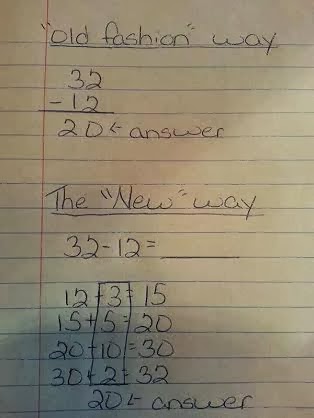
I honestly can't remember the source of this picture, although it came across my Facebook news feed repeatedly.  As parents, we know how we learned math.  The teacher showed us the traditional algorithm and we just did it. Concerned moms and dads constantly come into our center frustrated because they can't help their student since they "aren't doing it right."


Why does it have to be this way? Why are Common Core Standards making it more complicated? That is a huge national debate I will let the experts defend, but it is our kid's reality for now.  The powers that be want the kids to know where the numbers are coming from and improve number sense. For many kids, they don't need all the pitstops along the way to get to the answer and the requirement of dragging out a solution actually becomes a huge turn off of math in general, or leads to careless mistakes, or leaves them more confused than just going with the "old school" way.

At Mathnasium of 4S Ranch we are striving to support our students in the ways presented by their teachers, but to also let kids know sometimes there are other ways to reach the same answer. Isn't the bottom line 32-12=20. Kids need to build up their own personal toolbox of math kids that make sense to them so they can think on their feet in the real world.  All this work for 32-12 is for an early elementary math student, just imagine something more complex and the steps for prealgebra, algebra, geometry, trig or calculus!  No wonder frustrated parents are seeking out quality math tutoring.

This is why I love our tagline: We Make Math Make Sense. Visit or call our center in 92127 to learn more.

Friday, February 28, 2014

The Saddest Math Picture Ever

I literally felt punched in the stomach when this picture came across my news feed. A viral image taken by a professional photographer of her own 2nd grade child who is frustrated beyond belief over their math homework. Kids with high work ethics put so much pressure on themselves for perfection and have meltdowns when mistakes are made.  This was my son ten years ago.

My own son had plenty of moments like this in the 2nd-3rd grade window.  When we moved from Dallas to San Diego last summer we were both reminded of that period of time. The movers pulled back the big TV from the built in cabinet and there were six snapped pencil halves. My now 17 year old son noticed them first and asked why all the broken pencils were back there. I reminded him of all the temper tantrums he used to throw during homework time. He would go from hard worker to pencil snapper in a split second and throw the pencil across the room. Apparently some of those bits got trapped behind the TV.

We laughed it off since almost ten years had passed, but as a parent I remember calming him down, making him walk away for a while to clear his brain, and at times NOT turning in the homework on time as it was such a negative experience and I needed my kid to feel like a kid and be happy.

It was these situations that led me from stay at home mom to earning my teaching credentials, becoming an elementary school teacher, math curriculum writer, and ultimately an administrator responsible for integrating 21st Century skills into the lessons delivered on our elementary campus. I want kids to understand math. Not just the rules, but the whys. How did those numbers get there? How can I move them more flexibly?

Our math tutors offer quality math instruction that prepares elementary school children for middle school, middle schoolers for prealgebra and algebra, and supports all levels of high school math including advanced algebra, geometry, statistics, precalculus and calculus.

The outburst changes as the kids get older.  Tears and snapped pencils turn into mood swings, bad moods, withdrawn, insecurity of intelligence, and other self-esteem issues.  If you see this nightly, come talk to us and let's see if we can be of help. We identify and help fill critical math gaps, present lessons one on one so it makes sense to the child, and provide homework help so your time with them in the evening is less stressful.

Wednesday, February 26, 2014

"Less is More" can be Boring to Many

I came across an article highlighting efforts to teach math at an elementary school in rural Florida the other day. I agree whole-heartedly that students need to understand where and when numbers are coming from. I call it "building your math toolbox," and when the going gets tough in the math classroom, students can rely on those nuts and bolts lessons to kick start problem solving.

In the "Less is More" article they shared a day in a classroom where only four problems were covered.  On one, the teacher worked out a division problem that modeled 72 divided by 6 and proceeded to tally mark all 72 "somethings" into six circles.  This is necessary to demonstrated the operation of division, I've used the strategy myself (never with 72, however, as that would take FOREVER, she must love tally marks!) to distinguish two forms of division (when you know the groups but now how many is in the group or when you know how many are in the group but no idea how many groups there are). She is building number sense and experiences like this lead to numerical fluency in multiplication and division facts.

For the students who "get" division, though, that was probably the longest hour of their math lives.  Students with a rock solid math foundation would have picked up the process and procedure early on and were probably anxious to try their own. Only the class was stilllllll counting out 72 tally marks.  Maybe the class could have broke off into smaller problem solving groups or pairs for kids to try some on their own. That wasn't covered in the article, so it is unfair to say it didn't happen, but it does provide a snapshot of when your kid comes home and says they are bored in math class.

Enrichment in math is essential for kids who have the interest, requisite skills, and motivation to learn more.  Mathnasium is the perfect place for this as we build a customized learning plan around your student's abilities. Holes are filled initially (if there are any), but then introducing new concepts follows, and this sets your child up for success as their math options diversity after elementary school. Having a solid understanding of elementary leads to algebra-readiness.

Give a call to learn more and see how our Power Math Workouts will benefit your child long term.  858-312-8888.

The full article can be read:  http://wusfnews.wusf.usf.edu/post/why-less-more-rural-florida-school-preparing-common-core#.UwvdcFJLp4c.facebook

Sunglasses image retreived on 2/26/14 from: http://www.dogpile.com/info.dogpl.t10.4/search/images?fcoid=417&fcop=topnav&fpid=2&q=72+tally+marks&ql=

Thursday, February 20, 2014

What Makes Algebra Easier

I can't say these concepts make algebra easy, but definitely easier. Isn't that the goal? To make something completely understandable by having the proper math foundation that each lesson logically flows to the next?  For that to happen, a student's brick wall of math can't have missing bricks!

The National Math Advisor Panel stated way back in 2008 that there are three critical skills that students must master for algebra to go smoothly. They are:

  1. Effortless recall and fluency of basic math facts
  2. Fluency with fractions and how they interchange with decimals and percentages
  3. Certain aspects of geometry and measurement
To become fluent may occur naturally to some, but for others it takes practice.  Having a firm grip on where the numbers are coming from is a start. How do you turn a fraction into a decimal? Or vice versa? Does your student "get" that percents, fractions and decimals are three ways to show something of the same value?  That if we shared a cookie equally, I would get 50%, or 1/2, of .5 of that cookie. That benchmark is fairly easy, but what if there were eight of us sharing a twelve-cut pizza? I would get 11/2 slices, which is 1/8 of the pizza, or 12.5% of the pizza, or .125 of it.  If you know the mathematical process, you should be able to figure out sharing that pizza if there are seven people or 15 people.

Algebra readiness is essential since all prior math leads to algebra and your student's success in the course.  Success in algebra leads to further success for all future math. The pressure to get your child in algebra as early as possible is high but don't let it push your child into a math path they are not equipped to handle. Once they are in it they are in it. It can be a challenging and exciting path, or four years or frustration and struggle.

This summer Mathnasium of 4S Ranch will offer sessions to prepare your child for what lies ahead. Consider our summer sessions which include a "punch card" format to work flexibly with your summer plans.  Get their brain charged with algebraic thinking and practice the essential skills with quality math instructors who make math make sense so algebra is understood from Day 1. We are here to help!


Image retreived 2/19/14:  http://www.a4maths.com.au/userfiles/images/brickwall%20falling%20small.jpg

Wednesday, February 19, 2014

"Getting" Fractions Leads to Algebra Success

Fractions. We start off learning about them as sharing a pizza or a cookie equally among "x" number of people and it takes off from there. It is said among algebra teachers across the country, that having the ability to work flexibly with fractions (plus have great multiplication skills and a certain number of geometry and measurement skills, but I'll save that for another post) is essential for algebra success. It can be a matter of making or breaking your math path.


So how do we know if our kid is up for the algebra challenge? Are they "algebra ready?" Math standards even call these requisite skills algebra readiness for a reason. You need them to be ready for algebra.  These skills begin as young as third grade and build in complexity, so keeping up with the ramp up is key.

Students should be able to:
  • Recognize patterns with fractional parts and be able to "decompose" a fraction to its smallest form (EX: 3/4 = 1/4 + 1/4 + 1/4)
  • Find and create equivalent fractions 
  • Add, subtract, multiply and divide fractions with common or uncommon denominators
Somewhere along the way, fractions no longer became sharing pizza and cookies, it became probability, ratios, proportions, unit rates, and then comes algebra. Working flexibly with the whole numbers and fractional numbers is critical, but efficiency is just as important. If too much effort is expended on these "nuts and bolts" items, then they begin to slow down the problem solving process.  

If you find your child is not efficient or successful in their fraction sense, they could benefit from Mathnasium of 4S Ranch's program. We build a custom learning plan just for them and their needs and introduce every lesson in a way that makes sense to them. 

Common Core Math Standards can be reviewed here:  http://www.corestandards.org/assets/CCSSI_Math%20Standards.pdf


Tuesday, February 4, 2014

Need Math Help? Don't Call 911!

Here is a funny audio clip of a little one who needed help with their math so they called 911!  We know math help can be an emergency sometimes, and that's why we love that students can drop in and get the help they want exactly when they need it. Unlike the friendly, yet unhelpful, phone operator, our expert math tutors will walk struggling students through the problem solving process.
Common Core expectations have made math somewhat confusing to kids and their parents.  Much of the "answers" aren't necessarily numeric anymore. The requirement to not only solve, but to explain the steps you took to solve is essential.  Having a firm understanding of what you are doing and why you are doing it is essential.

So whether it's prealgebra or algebra help, geometry or even calculus, you just need to call 858-312-8888 to reach Mathnasium of 4S Ranch. We'll get you covered!

Enjoy:  http://www.wimp.com/kidmath/

Thursday, January 23, 2014

When Should You Get a Math Tutor for Your Student?

PBS recently ran an article on their website for parents struggling with when to hire a math tutor for their child.  Sometimes it is a pretty concrete clue: Grades are on the decline. Sometimes it is more of an instinct: Noticing avoidance strategies when it comes to math homework, excuses for why they can't finish, and general negative attitude changes.


When the time comes to making the jump, besides seeking a quality math tutor who is a math specialist, it is important to get to the root of the problem. Why is math getting harder? Was something missed along the way? Where bad habits started that need to be corrected? Is my high school student struggling with pre-algebra concepts but is enrolled in algebra? If your child struggles in one concept, are there other concepts where they could use math enrichment as well?

This makes Mathnasium perfect!  Our center in 4S Ranch fits the needs of anyone reading this article and saying, "This sounds like my kid." We begin with an assessment that identifies areas for growth or advancement. We create a customized learning plan that fits your child and we deliver it with one on one instruction to have the concepts make sense to the student. Once the student is ready, they are given independent time to practice their new strategy on a few problems before meeting with their math tutor and discussing their process a few minutes later.  We help with numerical fluency, number sense, elementary curriculum, algebra, geometry, pre-calculus and calculus help. 

The exchange between students and our math specialists is critical in cementing the math procedure and the student's confidence in tackling the math problem. Common Core math standards require students to communicate mathematically, and through careful questioning by Mathnasium of 4S Ranch's outstanding math tutors, students build their math vocabulary and problem solving abilities.


Image retrieved on 1/21/14 from: http://rack.3.mshcdn.com/media/ZgkyMDEyLzEyLzA0LzNiLzVmdW53YXlzdG9oLmFLUy5qcGcKcAl0aHVtYgk5NTB4NTM0IwplCWpwZw/906e116f/32e/5-fun-ways-to-help-your-kids-learn-math-online-141a0cd04c.jpg

Tuesday, January 21, 2014

Survey Says: "We're Not Good at Math"

I came across this survey and sat in silence!  1000 people were surveyed, all 18 years or above, and they were questioned on their self perception or feelings on math.  Grown ups that have at least had the opportunity to benefit from a full educational experience through the high school level.

They admitted to:

  • Struggles with math situations they come across in a typical day, like shopping, taxes, interest rates
  • Feeling frustrated when they have to use math authentically in real life
  • Difficulty when figuring out the discount on a sale or figuring out a server's tip
  • Feelings such as frustration, anxiety, worry and inadequacy

Sadly, women have a more harsh perception of themselves than men, a perception the educational system has been working tirelessly to correct.

With future jobs heading toward more and more STEM (Science, Technology, Engineering, and Math) skills, today's students cannot afford to have outcome. It will short change their opportunities and prospects for careers.

Mathnasium of 4S Ranch is more than math tutoring. Our top priority is build a student's success by making math make sense and instilling confidence as they work toward independence in the concepts they are studying.  We do this whether the child is struggling in math or visiting us for math enrichment.

After reading this article/survey, I feel more responsible than ever to make sure a future generation does have these same perceptions of themselves concerning math.  Students need to be adequately prepared to be successful and have the confidence. Elementary math is foundational to middle school math, such as pre-algebra and other algebra readiness courses. These directly feed into high school math success and impacts higher math concepts. The unfortunate thing about math is the train pulls out of the station in kindergarten and it doesn't stop. Once the struggle begins you have to address it or things slip away. Little by little at first, but at an alarming rate at some point. I have to think many in the survey were "those" kids. They may have gotten out of the class, but math shows up all the time in life's classroom (work, home, household budgets, big ticket purchases).


For the full article, please click here:

Image taken on 1/19/14 from: http://img.wallbeam.com/193processed/Bullet%20red%20train%20wallpaper%20hd.jpg

Sunday, January 19, 2014

Why Some Struggle with Math and Others Do Not

Think of all the exciting events that took place in 2013 and yet one of the most popular articles (#39 in its Top 100) written by Discover Magazine relates to "Why Some of Us are Better at Math Than Others."

Parents often greet me with "Why is number sense so hard for my child? We sit at the kitchen table every night and it just isn't clicking. I never had this problem as a child. I just don't get it." They are looking for solutions so their child can work more flexibly with numbers and build a foundation for future concepts. According to scientists, some are simply born with it, while others need to work at it.

Researchers from the country's greatest institutions, Duke, Johns Hopkins and Stanford, have been looking at experiences that make enhancing an individual's number sense so that success in higher math skills results.  Direct instruction, with a math tutor or teacher, has proven significant increases in math performance as concepts increase in complexity. That's awesome news and why places like Mathnasium of 4S Ranch is an outstanding option for math tutoring or math support.


Don't be afraid to start building number sense too early. One of the warm up activities we like to do with our younger students at Mathnasium of 4S Ranch is a game called Blink. It is a fast paced card game where you match cards in your hand to the target card in the center pile. You may match it by color, quantity or shape, all great concepts for math. Students "see" the quantities (just like you see a five on the cards pictured above), distinguish attributes of the shape or color, and race to get rid of their cards.

Here is the link to access the article.  A free subscription may be need to view it in its entirety: http://discovermagazine.com/2014/jan-feb/39-some-have-a-head-for-math?utm_medium=referral&utm_source=pulsenews#.UtlqXLQo6M_

Monday, December 16, 2013

Mathnasium Makes Kids CRAZY About Math

  • WARNING:  Your Kid Could Become Crazy About Math!  I love that sign and it is one of the first things parents mention to me as they consider Mathnasium math tutoring services for their student. They want their child to love math, they want them to understand and feel confident about their performance in math, and they want them to be open to the possibility that their career options could very well include math, so it is critical to keep their attitudes moving in the proper direction. 

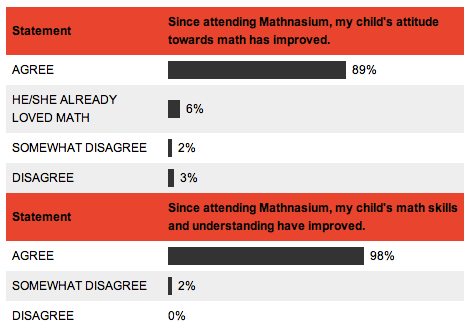
    In a 2010 national study, Mathnasium parents were polled so that we could learn how they felt about sending their children to our learning centers. The correlation between improved math skills and improved attitude is not a coincidence. Once you are better at something, don't you enjoy it more?  That goes for earning to play an instrument, excelling at a sport, long distance running, drawing, and hundreds of other examples. 

    Think about this mathematically, though. If 4th grade was OK, 5th was hard, how will middle school math feel? If your pre-algebra skills aren't mastered, algebra will be a bear. If Algebra 1/2 was rough, try sustaining that level of performance after taking a few months off for geometry.  How do these concerns effect a child's attitude? Poorly. They are scared. They feel incompetent. They start to dread the class, the homework, and, of course, test days! 

    Mathnasium of 4S Ranch is the perfect place to beef up those skills, dig back to make the course understandable through concepts and vocabulary, achieve algebra readiness, have qualified instructors assist with math homework help, receive math test preparation, get ACT or SAT test preparation in your 92127 neighborhood, or set the ground work for the next course so your student starts the trimester strong rather than digging themselves out of a hole. 

    The entire survey can be see here, but as far as our claim?  Consider yourself WARNED! 

Sunday, December 15, 2013

Friday the 13th Fun Fact

So I am off by two days, but I learned of these fun facts and didn't want to wait until the next Friday the 13th to share.


  • Friday 13 happens on every month that begins with a Sunday? 
  • Every year has at least one and at most three Friday the 13ths in it, but usually there are two
  • There can be two consecutive months with Friday the 13ths. Do you know which months they will always be?
  • Since a calendar repeats itself exactly once every 400 years, statisticians figured out that over those 4800 months (400 years x 12 months) the probability of it being Friday the 13th is .14333 or 688/4800 because 688 months had a Friday the 13th
  • If fact, when those people did all that crazy matter to figure out how ofter Friday the 13th happens, it turns out that Friday is the most common day of the week to fall on the 13th. (Since I know you are dying to know the least common day, here it is: Thursdays and Saturdays which happen 684/4800)
The people who figured this out must have had amazing math tutors or algebra help to figure this out. Too bad Mathnasium wasn't around back then!

Mathnasium and the Common Core Standards

Common Core Math Standards are definitely the buzz the past few years and I am often asked if the Mathnasium Method supports those standards. The answer is absolutely! Strengthening a student's algebra readiness is what it is all about for our younger friends.  Developing deeper problem solving skills and a firm understanding of the concepts is how we work with high school math students.

All of the Common Core math standards are included throughout our curriculum, but we have the luxury of of working outside of a grade level based on student performance. If a child is struggling, we pull lessons from lower grade levels. If they need enrichment, we pull lessons from higher grade levels. The main objective is to make math make sense, and by working with our students on their individualized learning plan they have the greatest opportunity for success!

To learn more, please refer to Mathnasium's Guide to the Common Core attached to the right.  For Common Core details by grade level, you will want to visit CommonCore.org.  Here, they list the grade level expectations and you can see the progression from concept to concept as it pertains to operations (add, subtract, multiply and divide), algebraic thinking (often called algebra readiness), fractions, measurement, data, and geometry.  Problem solving is addressed throughout these standards so students must have the ability to work with numbers flexibly (number fact knowledge as well as number sense) as the math progresses along grade levels.


Tuesday, December 10, 2013

What Makes Mathnasium Different?

We know you have options for math tutoring in 92127, 4S Ranch and the Rancho Bernardo areas.  Almost every parent that walks in the door is looking for help. A solution for their child's math progress: Whether that means reteaching concepts, strengthening existing skills, building on problem solving with the new Common Core Standards, or enrichment to not only keep up with the Jones, but be a Jone. They want to know what sets us apart from other programs. Here are just some of the many reasons why Mathnasium works!

In short, your child's customized learning plan paired with instructor led lessons, facilitated by math specialists, is the key!  This individualized attention is what builds student success. Doesn't everyone want a smile like this when it comes to understanding math?