I found this study to be very interesting. Stereotypically, math success associated with certain nationalities, especially with Chines and Japanese students, has always been the norm. As researched here, the language itself could be giving young students the kick start all kids need to make sense of numbers and how they work and build.
It has been recognized that the simple language parameters used by some countries limits confusion or misconceptions caused by a number's name. What exactly does "eleven" mean? Isn't it really just a ten and one more? Some languages use that to set the base with the English translation simply "ten-one." It even puts the ten first (as it would be in place value) before the number in the ones place.
Much of common core, and certainly the proprietary Mathnasium curriculum, translates numbers from fifty-five to 5 tens and 5 ones so students can regroup easier, multiply easier, and more. It's called decomposing a number and it makes harder numbers and complicated processes less hard.
The biggest "take home message" I read in this is that early numerical fluency sets any kid up for success, especially as the math gets more complex.
To see the article, please visit: http://online.wsj.com/articles/the-best-language-for-math-1410304008#printMode
Showing posts with label common core. Show all posts
Wednesday, September 24, 2014
Monday, September 22, 2014
Time Tested Curriculum! Improved again!
Katie Couric does a great job of breaking down Common Core. In her video for Yahoo! she addresses the goals/objectives of its existence, and how while the standards are national, the implementation is local. With this comes the growing pangs of trying and testing lessons that will drive the rigor while limiting confusion. As a former math curriculum writer myself, we spent summers rewriting quality lessons so that teachers could more easily and clearly deliver them to students. Often we would abandon a lesson because it was counter productive to the cause (too cumbersome, too wordy, not enough hands on).
http://news.yahoo.com/video/ now-common-core-012638311.html
What I love most about Mathnasium is that our curriculum is sound. With thirty years of experience in developing and refining our curriculum, it has become timeless. While we support Common Core wholeheartedly, we realize sound math is sound math. You can't learn B before A, if H isn't making sense then lets revisit G. Mathnasium hasn't rested on its already successful laurels. Our track record of success is outstanding, and yet this summer a revised curriculum launched to make math instruction more meaningful to our students!
I feel so lucky!
http://news.yahoo.com/video/
What I love most about Mathnasium is that our curriculum is sound. With thirty years of experience in developing and refining our curriculum, it has become timeless. While we support Common Core wholeheartedly, we realize sound math is sound math. You can't learn B before A, if H isn't making sense then lets revisit G. Mathnasium hasn't rested on its already successful laurels. Our track record of success is outstanding, and yet this summer a revised curriculum launched to make math instruction more meaningful to our students!
I feel so lucky!
Saturday, August 30, 2014
Reasonableness
With all the years I have been in education, whether from the side of a homework helping mother of two, the teacher for 3rd, 5th and Special Ed kids, elementary administrator, and as a math curriculum writer I don't think a day has gone by where the phrase, "Is this reasonable?" hasn't left my mouth.
So many times kids get so wrapped up in what it is they are doing that they don't stand back and ask themselves, "Is my answer reasonable?" Sure you have an answer, but go back and make sure it makes sense. This year, make this the new standard in your student's math life. The Common Core math standards require kids to explain their process and problem solving.
My favorite lesson in third grade was what I called "The Magic Brownie Pan." Students were given a bunch of information about a girl who baked two tray of brownies with a a dozen brownies in each. Four friends came over. Half had two brownies and half had three. How many brownies were left? There is a lot of data in the question. First of all, you need to know what "dozen" and "half" mean. You need to figure out how many brownies there are in the first place before you figure out how many are left. Inevitably a few kids will give me an answer greater than 24 brownies, maybe they added all the brownies to all the kids to how much each kid ate. I would joke about it not being a Magic Brownie Pan that miraculously bakes more brownies as kids are eating them. Those brownies are gone! Forever! There will be less than what was originally there, but how many exactly and how do we know we are right? What is our strategy?
Encourage your student to always check for reasonableness. The earlier they condition themselves for this type of scrutiny of their work, the greater the payoff down the road! For elementary math students, this will be key in becoming algebra-ready (also called pre-algebra) and success in higher level high school math courses.
If you need the support of math specialists, come to Mathnasium of 4S Ranch where our customized learning plans teach your student math skills, kids can get homework help, and math confidence is built.
So many times kids get so wrapped up in what it is they are doing that they don't stand back and ask themselves, "Is my answer reasonable?" Sure you have an answer, but go back and make sure it makes sense. This year, make this the new standard in your student's math life. The Common Core math standards require kids to explain their process and problem solving.
My favorite lesson in third grade was what I called "The Magic Brownie Pan." Students were given a bunch of information about a girl who baked two tray of brownies with a a dozen brownies in each. Four friends came over. Half had two brownies and half had three. How many brownies were left? There is a lot of data in the question. First of all, you need to know what "dozen" and "half" mean. You need to figure out how many brownies there are in the first place before you figure out how many are left. Inevitably a few kids will give me an answer greater than 24 brownies, maybe they added all the brownies to all the kids to how much each kid ate. I would joke about it not being a Magic Brownie Pan that miraculously bakes more brownies as kids are eating them. Those brownies are gone! Forever! There will be less than what was originally there, but how many exactly and how do we know we are right? What is our strategy?
Encourage your student to always check for reasonableness. The earlier they condition themselves for this type of scrutiny of their work, the greater the payoff down the road! For elementary math students, this will be key in becoming algebra-ready (also called pre-algebra) and success in higher level high school math courses.
If you need the support of math specialists, come to Mathnasium of 4S Ranch where our customized learning plans teach your student math skills, kids can get homework help, and math confidence is built.
Wednesday, April 30, 2014
National Honesty Day is Today
I didn't even know such a day existed such a day existed, but today is National Honesty Day. Apparently it was created to balance out the fact that the month is kicked off by April Fools Day. So a few "honest truths" about math. I learned these after taking a Stanford course last summer:
- There is no such thing as a "math person" or a "non-math person."
- Mindsets concerning math can be changed, but it takes time and effort, so those that consider themselves "non-math people" need to know they have the power to makes things different
- Mistakes in math are learning opportunities - sticking to it and powering through a tough concept may come with bumps and bruises, but ultimately makes for a better mathematician
- Boys are not better at math than girls. Girls are just as capable.
So if math is "hard" for your student, or if you are fearful of projecting your "non-math person" identity onto your child, know it can be turned around. Will it necessarily be easy - No. I have to be honest about that. The reality is, a student's future is highly dependent upon the opportunities they seize earlier in life, so working hard and "getting it" in elementary school leads to opportunities in middle school. Solid middle school performances opens the doors to advanced math and AP classes in high school which translate into getting into a four-year college, or even a select university, in the major of your choice.
Tuesday, April 29, 2014
Parents Helping with Homework Could Hurt Them
My morning routine always includes a news update from the Today Show. I will admit it is not exactly the hardest hitting news each day, but I love their balance between human interest and global segments. This morning they discussed The Broken Compass, a new book trending in American about how providing too much help, or helping too often, can actually negatively impact your student.
The book analyzed surveys of American families taken by the US Department of Education over the past thirty years. The ideas of parents "taking the reigns" or "taking over" during homework time, thus not allowing the child to do most of the work, dominates and is considered to be counterproductive to the cause. The goal would be for the kids to do as much work as possible, with you as a support system, so they can independently complete tests and quizzes successfully when in class (and away from the overhelping parent).
The Today Show joked about their own personal experiences in helping their own elementary kids with homework, but who can honestly say they have not uttered these same words at the end of a long day: "Let's get this over with" or the frustration you feel when something so clear to you isn't clear to your child, "It's right in front of you! The answer is right there!"
At Mathnasium of 4S Ranch, we provide the support system at homework time. Students will work with an instructor on a sampling of problems, and once they show understanding are released to complete some work independently. This builds confidence in the concept. Instructors then return to check over work and reteach if necessary. When kids walk out our doors they know they were the ones doing the work, not us, and their success in the classroom improves.
The book analyzed surveys of American families taken by the US Department of Education over the past thirty years. The ideas of parents "taking the reigns" or "taking over" during homework time, thus not allowing the child to do most of the work, dominates and is considered to be counterproductive to the cause. The goal would be for the kids to do as much work as possible, with you as a support system, so they can independently complete tests and quizzes successfully when in class (and away from the overhelping parent).
The Today Show joked about their own personal experiences in helping their own elementary kids with homework, but who can honestly say they have not uttered these same words at the end of a long day: "Let's get this over with" or the frustration you feel when something so clear to you isn't clear to your child, "It's right in front of you! The answer is right there!"
At Mathnasium of 4S Ranch, we provide the support system at homework time. Students will work with an instructor on a sampling of problems, and once they show understanding are released to complete some work independently. This builds confidence in the concept. Instructors then return to check over work and reteach if necessary. When kids walk out our doors they know they were the ones doing the work, not us, and their success in the classroom improves.
Friday, March 7, 2014
The "Common Core" Way to Problem Solve
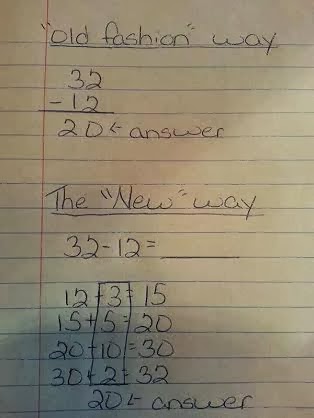
I honestly can't remember the source of this picture, although it came across my Facebook news feed repeatedly. As parents, we know how we learned math. The teacher showed us the traditional algorithm and we just did it. Concerned moms and dads constantly come into our center frustrated because they can't help their student since they "aren't doing it right."
Why does it have to be this way? Why are Common Core Standards making it more complicated? That is a huge national debate I will let the experts defend, but it is our kid's reality for now. The powers that be want the kids to know where the numbers are coming from and improve number sense. For many kids, they don't need all the pitstops along the way to get to the answer and the requirement of dragging out a solution actually becomes a huge turn off of math in general, or leads to careless mistakes, or leaves them more confused than just going with the "old school" way.
At Mathnasium of 4S Ranch we are striving to support our students in the ways presented by their teachers, but to also let kids know sometimes there are other ways to reach the same answer. Isn't the bottom line 32-12=20. Kids need to build up their own personal toolbox of math kids that make sense to them so they can think on their feet in the real world. All this work for 32-12 is for an early elementary math student, just imagine something more complex and the steps for prealgebra, algebra, geometry, trig or calculus! No wonder frustrated parents are seeking out quality math tutoring.
This is why I love our tagline: We Make Math Make Sense. Visit or call our center in 92127 to learn more.
Why does it have to be this way? Why are Common Core Standards making it more complicated? That is a huge national debate I will let the experts defend, but it is our kid's reality for now. The powers that be want the kids to know where the numbers are coming from and improve number sense. For many kids, they don't need all the pitstops along the way to get to the answer and the requirement of dragging out a solution actually becomes a huge turn off of math in general, or leads to careless mistakes, or leaves them more confused than just going with the "old school" way.
At Mathnasium of 4S Ranch we are striving to support our students in the ways presented by their teachers, but to also let kids know sometimes there are other ways to reach the same answer. Isn't the bottom line 32-12=20. Kids need to build up their own personal toolbox of math kids that make sense to them so they can think on their feet in the real world. All this work for 32-12 is for an early elementary math student, just imagine something more complex and the steps for prealgebra, algebra, geometry, trig or calculus! No wonder frustrated parents are seeking out quality math tutoring.
This is why I love our tagline: We Make Math Make Sense. Visit or call our center in 92127 to learn more.
Wednesday, February 26, 2014
"Less is More" can be Boring to Many
I came across an article highlighting efforts to teach math at an elementary school in rural Florida the other day. I agree whole-heartedly that students need to understand where and when numbers are coming from. I call it "building your math toolbox," and when the going gets tough in the math classroom, students can rely on those nuts and bolts lessons to kick start problem solving.
In the "Less is More" article they shared a day in a classroom where only four problems were covered. On one, the teacher worked out a division problem that modeled 72 divided by 6 and proceeded to tally mark all 72 "somethings" into six circles. This is necessary to demonstrated the operation of division, I've used the strategy myself (never with 72, however, as that would take FOREVER, she must love tally marks!) to distinguish two forms of division (when you know the groups but now how many is in the group or when you know how many are in the group but no idea how many groups there are). She is building number sense and experiences like this lead to numerical fluency in multiplication and division facts.
For the students who "get" division, though, that was probably the longest hour of their math lives. Students with a rock solid math foundation would have picked up the process and procedure early on and were probably anxious to try their own. Only the class was stilllllll counting out 72 tally marks. Maybe the class could have broke off into smaller problem solving groups or pairs for kids to try some on their own. That wasn't covered in the article, so it is unfair to say it didn't happen, but it does provide a snapshot of when your kid comes home and says they are bored in math class.
Enrichment in math is essential for kids who have the interest, requisite skills, and motivation to learn more. Mathnasium is the perfect place for this as we build a customized learning plan around your student's abilities. Holes are filled initially (if there are any), but then introducing new concepts follows, and this sets your child up for success as their math options diversity after elementary school. Having a solid understanding of elementary leads to algebra-readiness.
Give a call to learn more and see how our Power Math Workouts will benefit your child long term. 858-312-8888.
The full article can be read: http://wusfnews.wusf.usf.edu/post/why-less-more-rural-florida-school-preparing-common-core#.UwvdcFJLp4c.facebook
Sunglasses image retreived on 2/26/14 from: http://www.dogpile.com/info.dogpl.t10.4/search/images?fcoid=417&fcop=topnav&fpid=2&q=72+tally+marks&ql=
In the "Less is More" article they shared a day in a classroom where only four problems were covered. On one, the teacher worked out a division problem that modeled 72 divided by 6 and proceeded to tally mark all 72 "somethings" into six circles. This is necessary to demonstrated the operation of division, I've used the strategy myself (never with 72, however, as that would take FOREVER, she must love tally marks!) to distinguish two forms of division (when you know the groups but now how many is in the group or when you know how many are in the group but no idea how many groups there are). She is building number sense and experiences like this lead to numerical fluency in multiplication and division facts.
For the students who "get" division, though, that was probably the longest hour of their math lives. Students with a rock solid math foundation would have picked up the process and procedure early on and were probably anxious to try their own. Only the class was stilllllll counting out 72 tally marks. Maybe the class could have broke off into smaller problem solving groups or pairs for kids to try some on their own. That wasn't covered in the article, so it is unfair to say it didn't happen, but it does provide a snapshot of when your kid comes home and says they are bored in math class.
Enrichment in math is essential for kids who have the interest, requisite skills, and motivation to learn more. Mathnasium is the perfect place for this as we build a customized learning plan around your student's abilities. Holes are filled initially (if there are any), but then introducing new concepts follows, and this sets your child up for success as their math options diversity after elementary school. Having a solid understanding of elementary leads to algebra-readiness.
Give a call to learn more and see how our Power Math Workouts will benefit your child long term. 858-312-8888.
The full article can be read: http://wusfnews.wusf.usf.edu/post/why-less-more-rural-florida-school-preparing-common-core#.UwvdcFJLp4c.facebook
Sunglasses image retreived on 2/26/14 from: http://www.dogpile.com/info.dogpl.t10.4/search/images?fcoid=417&fcop=topnav&fpid=2&q=72+tally+marks&ql=
Sunday, December 15, 2013
Mathnasium and the Common Core Standards
Common Core Math Standards are definitely the buzz the past few years and I am often asked if the Mathnasium Method supports those standards. The answer is absolutely! Strengthening a student's algebra readiness is what it is all about for our younger friends. Developing deeper problem solving skills and a firm understanding of the concepts is how we work with high school math students.All of the Common Core math standards are included throughout our curriculum, but we have the luxury of of working outside of a grade level based on student performance. If a child is struggling, we pull lessons from lower grade levels. If they need enrichment, we pull lessons from higher grade levels. The main objective is to make math make sense, and by working with our students on their individualized learning plan they have the greatest opportunity for success!
To learn more, please refer to Mathnasium's Guide to the Common Core attached to the right. For Common Core details by grade level, you will want to visit CommonCore.org. Here, they list the grade level expectations and you can see the progression from concept to concept as it pertains to operations (add, subtract, multiply and divide), algebraic thinking (often called algebra readiness), fractions, measurement, data, and geometry. Problem solving is addressed throughout these standards so students must have the ability to work with numbers flexibly (number fact knowledge as well as number sense) as the math progresses along grade levels.
Subscribe to:
Posts (Atom)